Monday, 11 November 2013

Take a Look at Me Now (in San Francisco!) with Miranda Dickinson

I've been really keen to read Take a Look at Me Now ever since I got back from a trip to San Francisco and discovered that Miranda Dickinson had set her new novel there!
It's been great to revisit all my favourite places again with Nell Sullivan who loses her job at the Islington Planning Department, breaks with her boyfriend, Aidan, and blows her redundancy on a trip to stay with her cousin, Lizzie, in colourful Haight Ashbury.
It's quite a culture shock for Nell at first, but Miranda has such a way of immersing you in the story, that you are soon out there with Lizzie watching them turn the trams at the  Powell Street turnaround, and visiting the after school club where Lizzie helps out, and where she happens to be in love with the gorgeous principal, Tyler.
Or visiting Pier 39 to see Lizzie's friend Eric on his unicycle!

This diner is actually in Colorado!
A lot of the action takes place in Annie's Diner. Nell has always wanted to run a restaurant ever since a visit to New York with her friend, Vicky, who has also been made redundant, and Annie gives her a chance to get some work experience and meet her entertaining customers.
Life is going well for Nell, until she falls for the delectable Max Rossi.


So questions have to be answered, as the date for Nell's return to London looms nearer.
Should she stay in San Francisco with Max, or return home?
If she goes home what will she do for a job?
And what about all those messages from Aidan that she's been ignoring?


It's been a thoroughly good read, and I've really enjoyed it. I am also excited to hear that a new book is in the pipeline for next autumn, catching up with the story of Rosie Duncan who first appeared in Fairytale of New York! 

Which is your favourite Miranda Dickinson book?

Sunday, 3 November 2013

I Couldn't Put Down The Shadow Year by Hannah Richell!

Hannah Richell's done it again with her new novel, The Shadow Year!

It's 1980 and five graduates decide to spend a year at a dilapidated cottage by a lake in the Peak District: Kat, through whose eyes the story is told; Simon, the self-appointed leader of the group, and the man she's fancied all through uni; Ben and Carla, a couple who are better at growing food and cooking it than the others; and Mac, the quiet one, who at least has some idea of living off the land. Then Kat's sister, Freya, turns up . . .

In the present, Lila is left the key to the same cottage by a mysterious donor. She's just had a miscarriage after falling down the stairs. She can't come to terms with her loss, or remember the details of how it happened, and decides to take some time away from her husband, Tom, and go up to the cottage. After all she is an interior designer, perhaps she could so something with it?
When she arrives, she finds it's been uninhabited for some time and it looks as if the people left in a hurry, leaving everything just as it was.

The two halves of the story are told alternately, each reflecting what happens in the present with what happened in the past. Gradually, the pieces of the mystery are put together, and Lila finds out the terrible secret of what happened during that shadow year.

One of the images that Hannah uses through the book is honesty, the plant with the seed cases like the face of the moon. Honesty grows in the cottage garden, but also forms the theme of the story, about who is being honest and who is hiding a secret.
Another image is the alder trees sheltering the lake. They remind me of the poem by Charles Stuart Calverley called Shelter which mentions 'the wide weird lake where the alders sigh'. (You can find it here. It's worth a read.)
Walden Pond
This in turn brings me to the lake itself. In the epigraph, Hannah Richell quotes Henry Thoreau, talking about Walden Pond: he says that a lake is like the Earth's eye, and in this book the lake sees and reflects the drama that unfolds around it.

Apart from Hannah Richell's emotional descriptions and believable characters, she really has the skill to keep you guessing. I even found myself going through the possibilities, summing up what I knew and trying to work out what had happened, in just the same way I might work at one of my own plots!

This is Hannah's second novel, I reviewed Secrets of the Tides last year, and said that I just had to sit down and finish it! It's been the same with this one too!
I think it's a great book in the style of Jojo Moyes. Start reading it today, but make sure you're sitting comfortably: you won't want to stop!

Friday, 25 October 2013

How Paul McCartney, CS Lewis, and Reading on the Toilet got me into Writers' Forum this month!

It's been a good writing week for me in Writers' Forum: I've been mentioned three times!
Recently, Paula Williams was asking for writers to tell her about how their day job had inspired a story or a novel for her 'Ideas Store' column.
I wrote in and told her how working at a hotel where The Beatles had stayed in 1963 had prompted me to write about fourteen-year-old Molly who wanted to tell Paul McCartney that she loved him. (You can find out what happened in my collection of summer short stories, Postcards and Suntan Cream!)
I was really pleased to see that Paula had included my story. It was quite funny because a few years ago, I heard about her column and how it could inspire you to write and so I became a subscriber to the magazine. Now here I am in it myself!
There has also been a series by Douglas McPherson, helping you to break into non-fiction article writing. I never thought that I could do it. However, one day I watched The Lion, the Witch and the Wardrobe on TV, and remembered that CS Lewis had died 50 years ago, in November 1963, so began to write an article for practice. I saw that a free magazine had a few articles each month of local interest, and so, because Lewis lived in Oxford for many years, I pitched it to the editor. I was thrilled to be asked to write 500 words and afterwards told it would be in the November issue. On the back of this, I decided to write a letter to the 'Writers'Circle' letters page about it, and they printed it as well!
Lastly, I saw an article in the Metro newspaper reporting on a survey that said that one in 10 men and one in 30 women read their books on the toilet. It also went on to talk about the British people's lack of knowledge of Shakespeare and Dickens. I wrote it up for the 'Newsfront' digest and got it published too with my own byline!
I just shows what you can do, if you look for opportunities and act on them!

Sunday, 20 October 2013

Guest Interview - Liz Harris and A Bargain Struck

Hello Liz, and welcome to my blog. It's lovely to have you here today to talk about your new book A Bargain Struck.

Does a good deal make a marriage?
Widower Connor Maguire advertises for a wife to raise his young daughter, Bridget, work the homestead and bear him a son.

Ellen O’Sullivan longs for a home, a husband and a family. On paper, she is everything Connor needs in a wife. However, it soon becomes clear that Ellen has not been entirely truthful.

Will Connor be able to overlook Ellen’s dishonesty and keep to his side of the bargain? Or will Bridget’s resentment, the attentions of the beautiful Miss Quinn, and the arrival of an unwelcome visitor, combine to prevent the couple from starting anew.

As their personal feelings blur the boundaries of their deal, they begin to wonder if a bargain struck makes a marriage worth keeping.

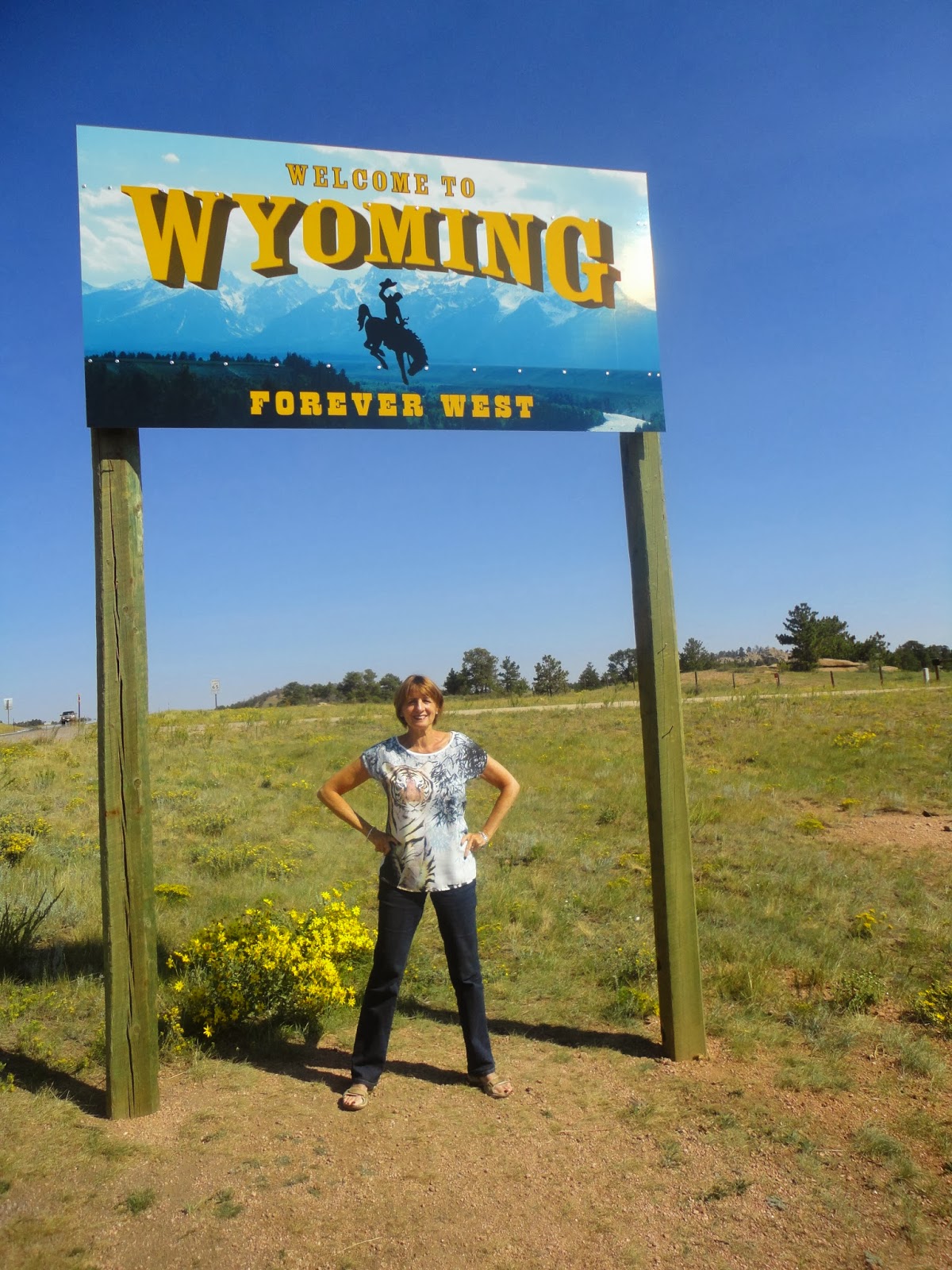
Set in Wyoming in 1887, a story of a man and a woman brought together through need, not love …

Wyoming is an ocean away from Ladakh, north of the Himalayas, where your first novel, The Road Back, was set. What made you choose nineteenth century America?

My starting point was the subject of the novel.

To wind the clock back. When wondering what novel to write after The Road Back, I knew only that I wanted it to be another historical novel, and that, having loved learning about the culture of Ladakh for The Road Back, I’d be happy to explore another culture again.

I was driving along the road one day, mulling over ideas for a novel, Radio 4 on in the background, when I heard the words ‘mail-order bride’. A bolt of excitement shot through me: I’d found the idea for my next novel.

I didn’t want to set the novel in Russia, however, which was the subject of the Radio 4 programme. Fortunately, I knew of an alternative, very romantic location where mail-order brides were fairly common – the American West in the mid-nineteenth century. And by the time I’d reached my destination, this had become the setting and period for A Bargain Struck.

How common was it for a man like Connor, a widower with a young daughter, to advertise for a wife to look after his homestead and bear him a son?

Fairly common. The men advertising might well have different backgrounds and characteristics, but their reasons would be pretty much the same.


For a man, the pioneering life meant working outside the house from dawn to dusk, cultivating the 160 acres allowed under The Homestead Act of 1862. He couldn’t, therefore, also tend the vegetable garden to provide food for their immediate needs, make their produce into preserves, cook the meals, make and wash their clothes, clean the house, look after any children. He needed a woman to do the woman’s work while he did the man’s work.

And he needed help in the fields and someone to take over the running of the homestead after him, which meant that he needed a wife rather than a housekeeper.

Ellen wasn't entirely honest about herself. Did you come across any other stories of women being economical with the truth in your research?
Not really, but I assume that women who were desperate to find a husband would be sparing about anything negative about themselves. I know that I would be!

When researching A Bargain Struck, I read a number of letters between men and women who were getting to know each other – although not in a mail-order bride situation - and I was struck by how down to earth they were and how mundane were the details in their letters. The pioneers of the American West were definitely not given to extravagance of expression. In fact, I’d go even further in saying that they clearly mistrusted ‘romantic’ feelings and avoided giving expression to them.

This makes sense when you realise that marriage was essentially a practical matter: both parties were working hard to make sure that there was food on the table and a future for the family. Expressing extreme feelings of either kind could jeopardise the harmony that they needed in order for their homestead to survive.

You have lived in America. Was writing about the Wild West something that you'd always wanted to do?
It’s a period that’s always fascinated me, but to be honest, for the six years that I lived in California, I wasn’t thinking about writing anything – I was far too busy enjoying the fabulous life I was having. I did read voraciously, though, and I devoured many books about the American West. My fascination with the period stayed with me after I returned to England, so hearing those words ‘mail-order bride’ when I was looking for an idea for the next book …


What are you working on at the moment, Liz? Is it set in another distant country?


I’ve just submitted the novel that will come out in September 2014. The working title is In a Far Place. That title might change, though. This time I don’t have Radio 4 to thank for the idea - I have the readers of The Road Back to thank for it.

I’ve received an amazing number of letters from people who’ve read The Road Back, and a number of readers have asked what happened to the missionaries’ son, Peter. When a fellow Choc Lit author asked me the same thing last November, I knew that I’d found the idea for the novel that I would be writing this last year, and that became In a Far Place. It is set in Cobar, on the edge of the outback in New South Wales, Australia so, yes, it is in another distant country. 

Now that I’ve finished the novel, I’ve started to write a novella set in the American West. I so enjoyed writing A Bargain Struck that I don’t feel ready to leave the period and setting just yet. After Christmas, I’ll be starting another full-length novel, which will be destined for publication in 2015, but in the meantime, I’m back in Wyoming in the 1880s.

I already have two ebooks out under the Choc Lit Lite label, Evie Undercover and The Art of Deception. This novella will, I hope, join them.

Your novels also have historical settings or connections. Which other place and time would you like to travel back to if you could?


That’s an interesting question and I’m not sure that I have an answer. I’d have to really feel strongly about a place to forego modern sanitation, and I’m not sure that anything grabs me enough to do that. Yes, trivial, I know!


And if I went back in time, there would always be the proviso that I would be one of those Upstairs and not one of those Downstairs, which might be against the time-travel rules. I just can’t see myself rolling up my sleeves and blacking a grate.

I think the truth is that I love the present, with all its faults and flaws, and have no real desire to go back in time anywhere other than in my head. However, when I’m writing about a period that interests me greatly and have immersed myself in the time and place, I would rather like the satisfaction of going back and seeing if I got it right.

Thank you for answering my questions today, Liz, and good luck with In a Far Place too!

A Bargain Struck is available from Apple iTunes, Kobo, Nook, and here on Amazon.

You can also find out more about Liz on her website:

Thursday, 10 October 2013

An Enormously English Monsoon Wedding - A very romantic story bathed in sunshine and kisses, or a clash of cultures catastrophe?


Dot Scribbles has been looking for some guest volunteers to review books on her excellent blog. On her list was An Enormously English Monsoon Wedding by Christina Jones; one that I had planned to read because its tagline was ‘Bollywood comes to Berkshire’ and it sounded crazy and exciting, so I was very pleased to be chosen!
Christina Jones has written a very romantic story bathed in sunshine and kisses which makes you hope that it won’t turn out to be a clash of cultures catastrophe!
Erin fell in love with Jay, Nook Green’s village vet, when he saved the life of her beloved cat, Florence. Now two years later, they have planned the perfect wedding at the Swan Hotel. And there’s only six weeks to go. They’ve chosen a civil ceremony so as not to upset either set of parents, and Erin has chosen the most beautiful dress. As they stroll through the hotel grounds to meet Jay’s parents, Deena and Tavish, everything in the garden is lovely, until lunchtime when his mother starts to question their plans and makes it clear that she expects them to have a more traditional Indian wedding. On top of this they have brought Nalisha, Jay’s childhood sweetheart, with them!
The village has some other memorable characters: Kam, Jay’s cousin and also a vet; Gina who runs the Merry Cobbler; Uncle Doug who owns The Old Curiosity Shop where Erin works; and Erin’s parents, Rose and Pete, who arrive from Australia. I particularly like the part when Deena takes Erin and her mother to buy Rose a wedding outfit.
Christina grew up in a similar close-knit Berkshire village, and has recently been involved in her daughter’s fusion wedding which, she says, went more smoothly than Erin and Jay’s! Therefore, she had lots of material to base her story on which makes it ring true.
It’s difficult to write about this book without giving too much away. Christina describes it as a ‘Bucolic Frolic’, and it is romantic and funny: perfect to read on holiday or at home by a roaring fire. I really felt for poor Erin and Jay and I was gripped by the story, which has some surprising twists and turns and Bollywood moments, to find out whether Deena gets her way or not.
This is the first book that I’ve read by Christina Jones. She’s writing three more in this series, set in the surrounding fictional Berkshire villages she mentions in this book, and I will certainly be looking out for them.
This review is being published simultaneously today on both our blogs. If you haven't seen Dot's blog yet, it's well worth going over and having a browse at the wide selection of books that she's reviewed. Here's the link:)

Sunday, 22 September 2013

Newbury Show - A Great Place for Historical Research and Inspiration for Writers!


I've just spent another great day at the Newbury show or more correctly, The Royal County of Berkshire Show. We've been going for twenty years, so it must be good!
There are always fascinating things to see such as these Heavy Horse Trade Turnouts. Just imagine moving house and loading everything into this removal van. What could go wrong on the journey from Bournemouth to Winchester, for example? Or perhaps the story could be told from the horses' point of view?


Drays like this would deliver beer from the local town brewery to all the pubs in the area. Imagine the draymen unloading the wooden barrels and rolling them down through the trapdoor in the pavement to the cellar beneath the pub.


This cart had an agricultural use as well as a trade use. The axels are wide enough to be drawn across a field in the furrows where farm workers would load it up to the name plate behind the driver's shoulders with cabbages and other brassicas. Then it would be driven straight to Covent Garden for the vegetables to be sold and the cart would make a return journey with supplies from London for the village.
Who could be waiting for a special package to be brought home?


This year there was also a World War II Village to give a glimpse of life on the Home Front.


This van really reminds me of Dad's Army!
Both these vehicles must have some stories to tell.


Here is a reconstruction of a Dig for Victory garden. There were Land Girls on hand to explain  how important food production was when Britain had to rely on its own resources for food. There could be a story where people are competing to grow the best marrow. The winning one gets stolen, and the village have to find the culprit before it's eaten up!


The show always ends with a mass assent of hot air balloons, and here is the first one which is rather an unusual cube shape. An idea for another story perhaps? Someone's first balloon flight and the balloon gets out of control and comes down in a farmer's field or maybe a shopping centre car park!


Newbury Show is the last county show of the season, but they start again next spring. Look out for your local one and see if you can get some inspiration for your writing like me!


Saturday, 21 September 2013

Summer of '76 by Isabel Ashdown - A Great Read for a Summery Weekend

The Autumnal Equinox is officially at 20.44 GMT on Sunday, 22nd September, so you have a weekend left to read this novel about the hot Summer of '76 by Isabel Ashdown! On the other hand it can be enjoyed anytime when you want to remember the halcyon days of this summer, perhaps when the autumn winds are blowing or it's snowing in January!
It's a coming of age story set on the Isle of Wight, about seventeen-year-old Luke, his family, and friends during that long hot summer of 1976.
In some ways it's like The Age of Miracles by Karen Thompson Walker where the heat affects everyone's behaviour which I reviewed recently.
As Diana, one of Isabel Ashdown's characters says:
'It's the heat; the endless summer. We live on this tiny island, and no one knows what to do about the sun when it just won't stop shining, so we all go a little mad, because it feels it's just a dream that will be gone when we wake up tomorrow.'

Luke is spending his last summer on the island before he goes off to Brighton Poly, working at the campsite with Samantha whom he fancies, and helping his friend Martin with his problems, but under the surface of all this fairly normal story is the scandal that is gripping the town, and the part that Luke and Martin play in uncovering the truth.
It is a gripping read, and Isabel has drawn a picture of life in the mid-seventies very well. It is always difficult to write about a time well within living memory and she has captured the era perfectly right down to Luke's favourite pudding made from shop bought swiss roll and custard!
I thoroughly recommend this book and I will be looking out for her other ones.
Have you read any of Isabel Ashdown's novels?